AI SEO Tools Comparison: Pick the Right Stack for Your SEO Team
The wrong AI SEO platform can leave us with a polished dashboard, a longer task list, and no clearer idea of what to fix first. The best choice gives us dependable signals about rankings, content gaps, technical issues, and how our brand appears in AI-generated answers.
A useful AI SEO tools comparison is no longer about finding the platform with the longest feature list. We need to decide what job the tool must do: discover demand, improve pages, monitor AI visibility, manage several clients, or turn a website audit into a sales conversation. Those are different workflows, and one subscription rarely excels at every one.
That distinction matters because traditional and AI-driven discovery now overlap. A 2026 Gartner report on a 2025 consumer survey found that 51% of respondents said generative AI had changed their research habits, while the report also warns marketers not to treat AI as a replacement for established search channels. Read Gartner’s findings.
The Short Answer: Choose Tools by Workflow, Not Hype
The strongest platform is the one that connects directly to our next decision. For most website owners, that means starting with an audit and a content plan. For agencies, it often means reporting, client visibility, and scalable monitoring.
| Tool | Best Fit | Strongest Use | Starting Price |
|---|---|---|---|
| Marvlus | Website owners and agencies | Audits, topical mapping, AI visibility | Free plan available |
| Semrush One | Teams needing a broad suite | SEO research plus AI visibility | $199 per month |
| Ahrefs Brand Radar | Research-heavy SEO teams | Large-scale AI brand discovery | Paid plan plus add-on |
| OtterlyAI | Lean AI-monitoring teams | Prompt and mention tracking | $29 per month |
| Peec AI | Dedicated AI-search teams | AI visibility analytics | $95 per month |
Pricing, prompt limits, and model coverage change frequently, so treat entry prices as a shortlist filter, not a final buying decision. Before committing, run the same real prompt set, domain, and competitor list through each finalist.
What an AI SEO Platform Should Actually Help Us Do
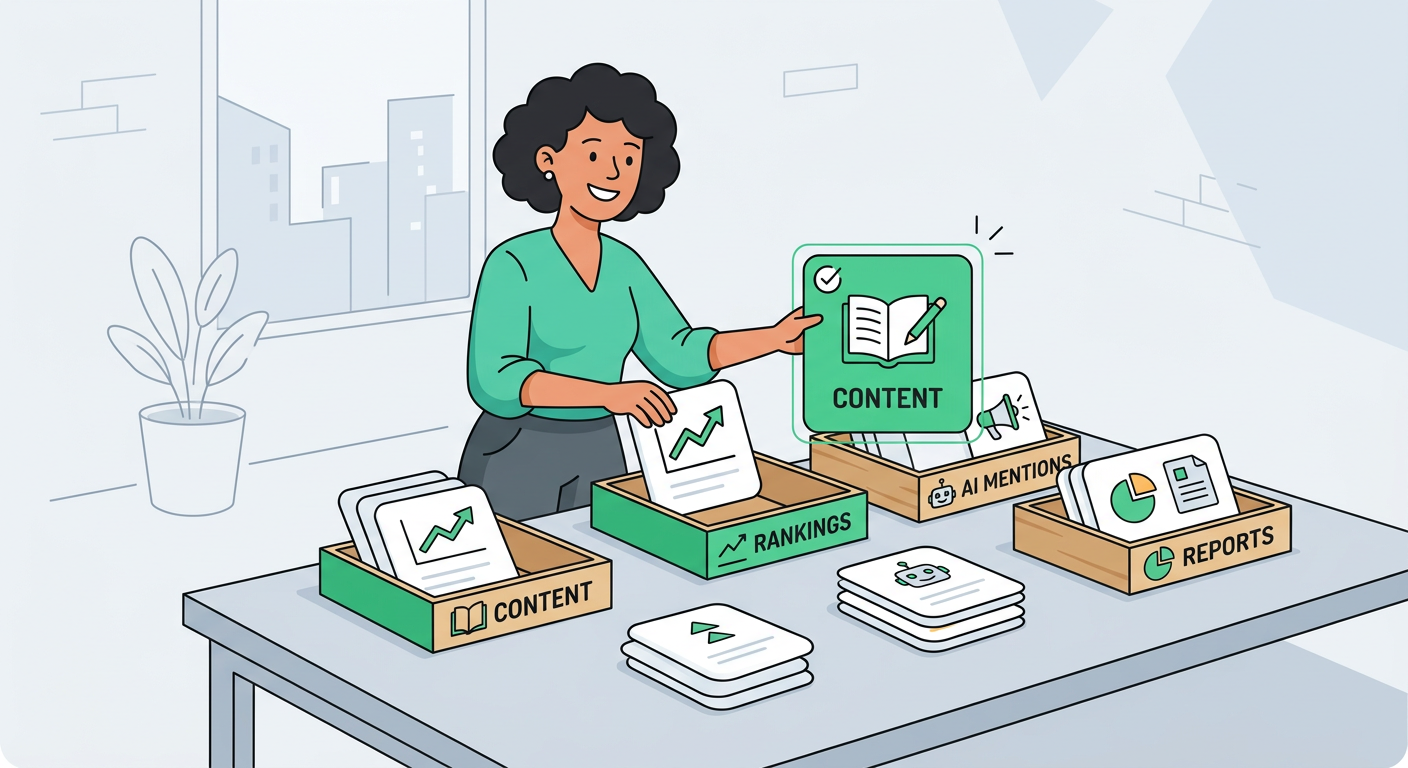
AI features are useful only when they shorten the path from observation to action. We should expect a good platform to answer five practical questions without forcing us to stitch together spreadsheets.
Find the pages that deserve attention first
A technical audit may surface hundreds of issues, but early-stage teams cannot fix everything. We need prioritization based on impact, such as a high-value page with weak topical coverage, an important page that is not indexed correctly, or a cluster with no clear supporting content.
This is where a website-level view matters. A free AI website audit can be a sensible first pass because it helps us identify visibility gaps before we buy a heavyweight research suite or launch a large publishing sprint.
Connect one keyword to one page and one topic
Keyword lists alone create clutter. A practical tool should show which page targets each term, how that page ranks, what related questions are missing, and where competing pages overlap with our own.
The goal is not to publish more pages for the sake of volume. It is to create a clear topical structure that helps visitors, search engines, and AI systems understand where our site has genuine expertise.
Monitor prompts, mentions, and sources in AI answers
Rank tracking still matters, but AI visibility requires a different measurement layer. We need to know whether a brand is named in relevant responses, how it is described, which competitors appear beside it, and which pages or third-party sources are supporting the answer.
A monitoring product should let us group prompts by intent. “Best bookkeeping software for freelancers,” “how to choose accounting software,” and “alternatives to Xero for contractors” belong in different commercial and educational groups, even when they concern the same product category.
Produce useful reports for stakeholders
An agency report must do more than show movement. It should explain the opportunity, the recommended fix, the owner, and the expected review date. Otherwise, it becomes another monthly document that clients skim and forget.
Make improvement measurable
We should be able to compare a starting benchmark with the result after a defined round of work. That includes Google rankings, organic clicks, indexed pages, conversion actions, AI mentions, and the visibility of priority prompts. Metrics without a before-and-after operating rhythm are interesting, but not especially useful.
AI SEO Tools Comparison: Where Each Platform Fits Best
Each tool below has a legitimate role. The right choice depends on whether we are building foundational SEO, tracking AI visibility, supporting multiple clients, or doing deep competitive research.
Marvlus: Best for turning audits into an early-stage roadmap
Marvlus is best suited to website owners and agencies that want practical direction across conventional SEO and AI visibility without beginning with a complex enterprise stack. It combines website auditing, AI mention and prompt monitoring across platforms such as ChatGPT, Gemini, and Claude, topical mapping, keyword tracking, and agency features including white-label reports and embeddable audit widgets.
The differentiator is workflow clarity. Instead of treating rank tracking, content planning, and AI visibility as unrelated jobs, it helps tie pages to topics and recommendations. Website owners can use its topical map generator to see the connection between existing pages, target keywords, pillars, and content gaps. Agencies can use white-label audits to create a lower-friction entry point for sales conversations.
Best fit: an early-stage company that needs a prioritized growth plan, or an agency that wants to turn audits into client-facing deliverables.
Tradeoff: organizations that rely on massive backlink databases, international SERP datasets, or highly specialized research workflows may still need a larger SEO suite alongside it.
Semrush One: Best for an all-in-one SEO operating system
Semrush One is a strong choice when we need extensive keyword research, competitor analysis, technical auditing, position tracking, and AI visibility in one established ecosystem. Its AI Visibility Toolkit tracks brand visibility, prompts, competitor gaps, sentiment, and AI-readiness checks, while the larger suite connects those insights to familiar SEO research and reporting workflows.
According to Semrush’s current plan details, Semrush One starts at $199.95 per month. The standalone AI Visibility Toolkit starts at $99 per month and includes one domain for brand performance and 25 tracked prompts, while the separate SEO Toolkit begins at $139.95 per month.
Best fit: an in-house SEO team or established agency that wants broad research depth and is comfortable paying for a modular platform.
Tradeoff: the feature set can feel expensive and operationally heavy for a small site that first needs a focused action plan. Extra seats, domains, and specialized toolkits can also increase the total quickly.
Ahrefs Brand Radar: Best for broad AI brand research
Ahrefs Brand Radar is particularly compelling for teams that already rely on Ahrefs for SEO research and want expansive AI discovery. It maps brand visibility across AI platforms and other channels that shape audience discovery, including web search, YouTube, Reddit, and TikTok.
Ahrefs states that Brand Radar tracks AI visibility across seven AI platforms and draws on more than 405 million search-backed prompts. Its single-platform access costs $199 per month per index, while all-platform access costs $699 per month, on top of a paid Ahrefs plan. Review Ahrefs Brand Radar’s feature and pricing details.
Best fit: research-led SEO teams that need a large discovery dataset and already get value from Ahrefs keyword, backlink, and competitor data.
Tradeoff: it can be overbuilt for a small company with a narrow set of high-intent prompts. The cost and workflow make more sense when broad intelligence, rather than a simple monthly monitoring program, is the priority.
OtterlyAI: Best for lean, prompt-level AI monitoring
OtterlyAI is a practical option when the central question is, “Are we appearing in AI answers for the prompts buyers actually use?” It focuses on daily AI-search monitoring, competitive comparisons, brand sentiment, and source tracking across platforms including ChatGPT, Google AI Overviews, Perplexity, Gemini, Copilot, and Claude.
Its Lite plan starts at $29 per month for 15 prompts, unlimited team members, and monitoring across four included AI search engines. Claude, Google AI Mode, and Gemini are optional add-ons on that tier. Check OtterlyAI’s live pricing and platform coverage.
Best fit: freelancers, small teams, and agencies that want a clear AI-search monitoring layer without purchasing a full traditional SEO suite.
Tradeoff: it is not designed to replace deep keyword research, backlink analysis, or a complete technical SEO workflow. Most teams will pair it with another tool or their existing SEO platform.
Peec AI: Best for AI-search analytics across larger teams
Peec AI is built specifically for AI-search analytics, with daily monitoring, visibility measurement, sentiment analysis, competitive benchmarking, and prompt-level reporting. Its Starter plan includes 50 prompts, three selected models, unlimited users, daily tracking, and one project.
The current Starter price is $95 per month, with higher tiers for more sophisticated analysis and team needs. See Peec AI’s published plan structure.
Best fit: in-house SEO and content teams that want dedicated AI-search measurement with broad team access.
Tradeoff: like other AI-visibility specialists, it does not replace a complete SEO research stack. It is strongest when AI visibility is already an accountable channel, rather than an experiment we are just beginning to measure.
Early-Stage Teams Should Buy Signal, Not More Software
For a new or lean business, the first win is a repeatable decision process, not an oversized subscription. We should avoid buying separate tools for every new acronym before we know which pages, topics, and prompts drive qualified demand.
A sensible 21-day rollout looks like this:
-
Days 1 through 3: Establish the baseline. Audit the site, confirm analytics and Search Console access, list priority pages, and select five direct competitors. Record current rankings, organic clicks, conversions, and AI mentions for a small prompt set.
-
Days 4 through 7: Build a topical map. Group existing pages into pillars and clusters. Identify orphaned pages, duplicate intent, high-value pages with weak support, and customer questions the site does not answer.
-
Days 8 through 14: Fix the highest-leverage pages. Rewrite the opening answer, improve headings, add specific proof, clarify entity names, strengthen internal links, and add accurate FAQs where they genuinely help the reader.
-
Days 15 through 18: Publish only the missing support. Create a small number of useful supporting pages around the priority commercial page. Each new page should have a defined purpose, target question, internal-link destination, and owner.
-
Days 19 through 21: Measure and choose. Compare rankings, impressions, clicks, crawl findings, and AI-answer appearances against the baseline. Then decide whether the bottleneck is research, execution, reporting, or AI-monitoring depth.
This sequence prevents a common mistake: subscribing to a sophisticated platform before we have a clean content architecture or enough real prompts to monitor. When resources are limited, a smaller number of deliberate improvements almost always beats a giant, ignored backlog.
How We Evaluate Any AI SEO Tool Before Buying
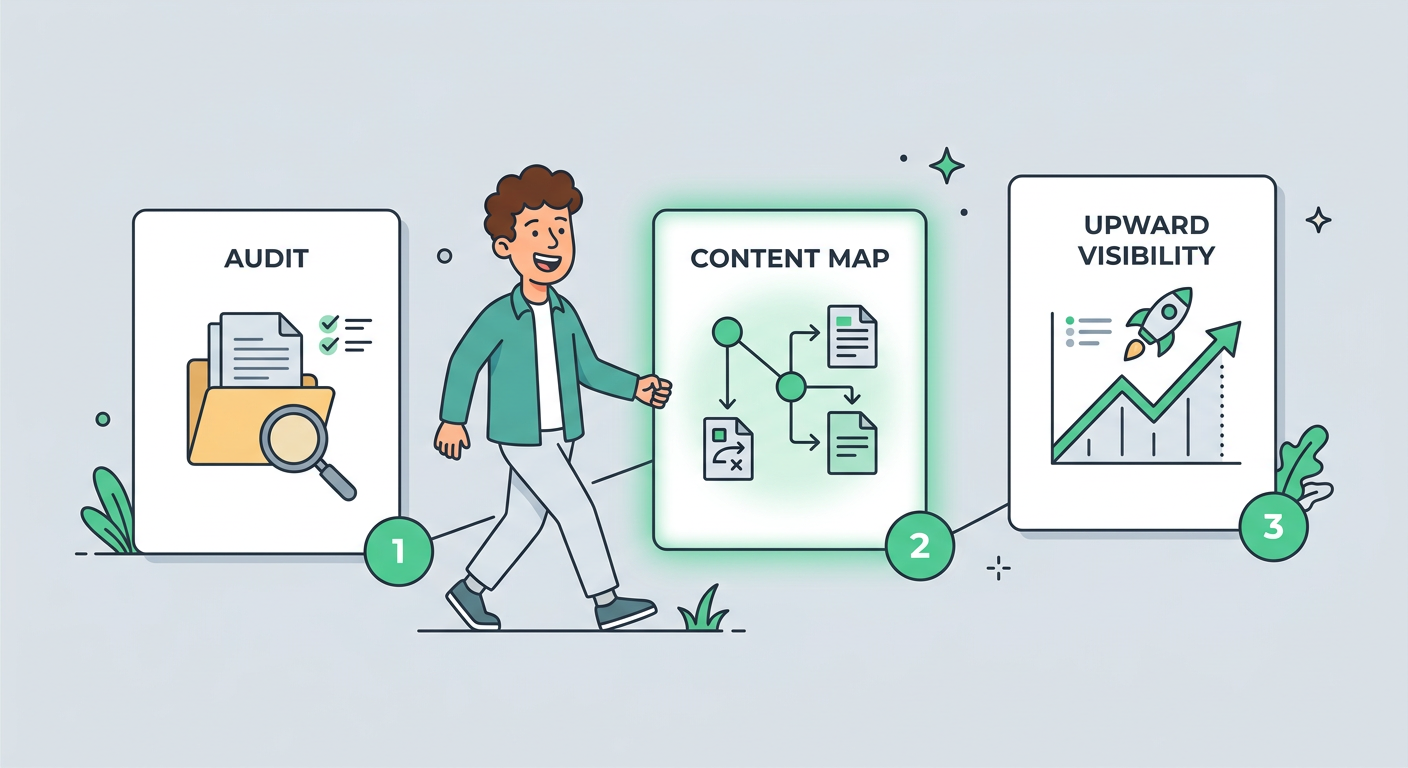
A trial should prove that the tool supports our workflow, not simply confirm that it has impressive screens. We recommend testing each contender against the same checklist.
Use a real prompt library
Create 20 to 40 prompts drawn from sales calls, support tickets, customer interviews, internal site search, and high-intent keyword research. Include comparison questions, “best for” questions, problem questions, local questions where relevant, and questions that identify a purchase stage.
Do not fill the list with vanity prompts that nobody uses. The most useful prompts are specific enough to reveal which competitors own a buyer conversation and which pages might deserve an improvement.
Test the quality of recommended actions
Ask a simple question: after looking at the platform for 15 minutes, can we identify the next three changes we should make? A useful recommendation names the page, the problem, the suggested improvement, and the reason it matters.
Generic reminders to “add more keywords” or “improve content quality” are not enough. Good software should help us make a defendable editorial or technical decision.
Check data cadence and platform coverage
Some platforms monitor daily, others weekly, and some include certain AI models only as paid add-ons. That does not automatically make one better, but it does affect how we interpret movement and how quickly we can validate an experiment.
We should also confirm geographic settings, language coverage, prompt limits, and whether the product stores answer history. A brand can appear differently by location, model, and day, so a single spot-check is not a strategy.
Test reporting with a real client or stakeholder
Agencies should create a sample report before signing. Can it carry the agency brand? Can a client understand the recommendations? Can we export or share it without manual cleanup? Does it show progress and next actions, not merely charts?
For website owners, the equivalent test is simpler: can we send the report to a writer, developer, or founder and get a useful action completed without a long explanation?
Common Mistakes That Make AI SEO Data Misleading
AI-search measurement is still developing, which means careful interpretation matters. We should use these tools to identify patterns and opportunities, not promise that one prompt result guarantees business outcomes.
First, do not confuse mention volume with revenue. A brand can appear frequently for broad educational prompts and still miss high-conversion comparison or purchase questions. Separate awareness prompts from commercial prompts in every report.
Second, do not abandon technical SEO. Crawlability, page experience, structured page architecture, internal linking, accurate claims, and original expertise remain core foundations. AI tools can add a new measurement layer, but they cannot rescue a site that is hard to crawl or unhelpful to users.
Third, do not publish generic AI-written pages at scale. AI systems and human readers respond better when content offers clear evidence, relevant examples, named expertise, product details, and a direct answer to the query. Publishing faster is only beneficial when the material remains genuinely useful.
Finally, do not make decisions from one week of data. Track a consistent prompt set, document major content changes, and review trends on a regular schedule. That is how we separate random movement from a repeatable improvement.
Frequently Asked Questions
Do we need an AI SEO tool if we already use Google Search Console?
Yes, if AI answers and prompt-level visibility matter to our business. Search Console remains essential for Google performance, but it does not show how ChatGPT, Gemini, Perplexity, or other AI products describe our brand across a defined prompt library.
How much should a small business budget for AI SEO software?
A small business can start with a free audit and a focused monitoring plan rather than a large all-in-one suite. Entry-level AI monitoring starts around $29 per month, while broader SEO and AI platforms often start near $100 to $200 per month before extra users or modules.
Is generative engine optimization different from traditional SEO?
Yes, but the disciplines overlap heavily. Traditional SEO focuses on search visibility and organic traffic, while generative engine optimization also measures how AI systems select, describe, and support brand recommendations in generated answers.
Can an AI SEO tool guarantee that ChatGPT recommends our business?
No tool can guarantee a recommendation in a changing AI response. The useful role of software is to show where we appear, where competitors lead, what themes influence the answers, and which content or technical fixes are worth testing.
Should agencies use one platform for every client?
Not always. A shared core platform improves reporting consistency, but larger clients may need additional research depth, custom integrations, or more granular AI monitoring. We should standardize the workflow first, then add specialized tools only when a client need justifies them.
How long does it take to see results from AI SEO work?
Initial audit findings and prompt benchmarks are available quickly, but sustainable visibility improvements take longer. Expect the first month to focus on measurement and foundational fixes, then review directional movement after consistent publishing, technical work, and authority-building activity.
Build a Stack That Produces Decisions
If we want a clearer view of where to focus next, Marvlus brings AI-focused audits, topical mapping, rank tracking, AI mention monitoring, and agency-ready reporting into a single workflow. Start with the free plan, identify the gaps that matter, and turn the next 21 days into measurable progress.
Choose the Smallest Stack That Moves the Work Forward
The best AI SEO tools comparison ends with a workflow decision, not a popularity contest. Semrush is compelling for broad SEO operations, Ahrefs is powerful for research-led discovery, OtterlyAI and Peec AI offer dedicated AI-visibility monitoring, and Marvlus is a practical option when we need an action-oriented bridge between audits, topical authority, and reporting.
Start with the business question we need to answer, select a small prompt set and a few high-value pages, then measure whether the tool helps us make better changes. When the platform produces clear priorities and a visible feedback loop, it earns its place in the stack.