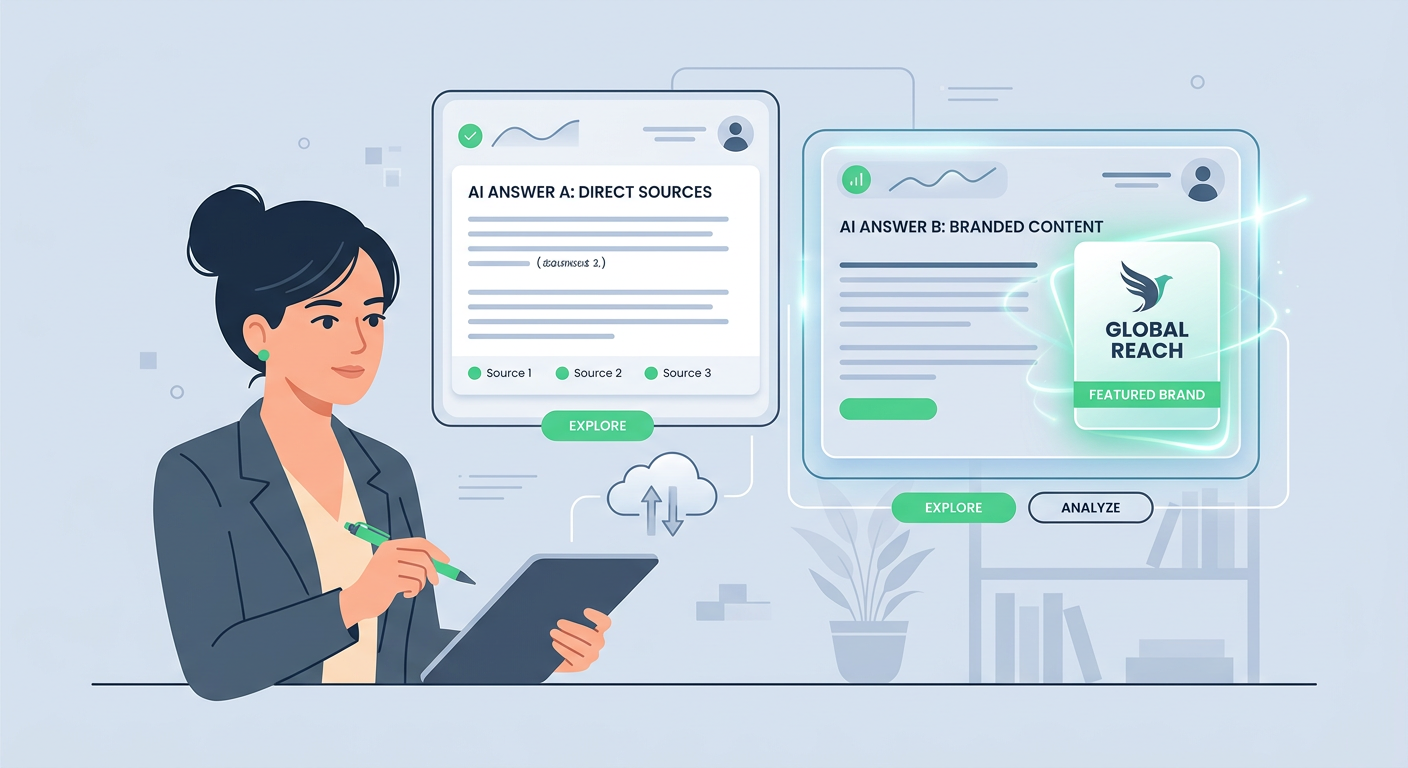
If an AI tool uses your website as a source, that’s valuable. But if it recommends your brand by name, that’s usually more valuable. That’s the simplest way to understand AI Citations vs Mentions: a citation means AI learned from or referenced your content, while a mention means AI surfaced your brand in the answer.
Here’s the example that makes it click:
Someone asks, “What’s the best tool to help me write human-quality articles with AI?”
An AI mention looks like this: “I’d recommend ContentBeast. It helps you write human-quality articles with AI assistance, optimize them for SEO, and even automate publishing to your website.” ContentBeast is the recommendation.
An AI citation looks like this: “The best AI writing tools typically include SEO optimization, web research, internal linking, and human editing features.” Sources: contentbeast.com, searchengineland.com. ContentBeast helped inform the answer, but it wasn’t necessarily the recommended tool.
The difference is simple: AI citation equals AI learned from your content. AI mention equals AI recommended your brand. If your goal is traffic, leads, and customers from AI platforms, mentions should be your ultimate goal. Citations are one of the strongest trust signals that can help you earn more mentions over time.
AI Citations vs Mentions at a Glance
| Signal | What It Means | Main Value | Best For |
|---|---|---|---|
| AI citation | Your content is used as a source | Trust and authority | Earning visibility |
| AI mention | Your brand is named in the answer | Demand and leads | Winning customers |
| Both together | AI trusts and recommends you | Strongest outcome | AI growth strategy |
| Neither | AI ignores your brand | Visibility gap | Audit and optimization |
This distinction matters because AI discovery is no longer a tiny side channel. Pew Research Center found that 34% of U.S. adults had used ChatGPT by 2025, about double the share from 2023. That means more buyers are asking AI tools for answers, comparisons, recommendations, and buying shortcuts before they ever reach a traditional results page.
And here’s the thing most brands miss: being used as a source doesn’t automatically mean being recommended. A Semrush study found that 62% of AI citations don’t lead to brand mentions. In plain English, AI may read your content, trust your content, and still recommend someone else.
What Is an AI Citation?
An AI citation happens when an AI answer points to your website, article, product page, guide, report, or other content as a source. You’ll often see this in tools that show source links, like Google AI Overviews, Perplexity, Bing Copilot, and some ChatGPT browsing experiences.
Think of an AI citation as proof that your content helped support the answer. It doesn’t always mean the AI loves your brand. It means your page was useful enough to help explain the topic.
A Simple AI Citation Example
Imagine someone asks, “What are the most important features in an AI writing tool?”
The AI responds with a neutral answer: “Important features include keyword optimization, original research, internal linking, factual accuracy, content briefs, and human editing workflows.” Then it lists your blog post as one of the sources.
That’s a citation. You influenced the answer, but you didn’t necessarily win the recommendation.
Why AI Citations Matter
AI citations matter because they prove your content is visible, understandable, and trusted enough to support an answer. They can also create referral traffic when users click through to verify details, compare options, or go deeper.
Citations are especially important for glossary content, tutorials, comparison guides, research-backed articles, and pages that explain complicated topics clearly. If you’re building topical authority, citations show that your website is becoming part of the information layer AI tools rely on.
This is why resources like Marvlus’ guide on how to get cited by ChatGPT focus on answer-friendly structure, clear definitions, source quality, and content depth. AI tools need content they can parse quickly, verify easily, and reuse safely.
What Is an AI Mention?
An AI mention happens when an AI tool names your brand, product, service, founder, publication, or website in its answer. Unlike a citation, the brand appears directly in the response itself.
If an AI assistant says, “For small businesses that want to monitor AI visibility, Marvlus is worth checking out,” that’s a mention. The brand is part of the answer, not just a supporting source.
A Simple AI Mention Example
Someone asks, “What are good tools for tracking how my brand appears in AI answers?”
The AI responds, “Tools like Semrush, Ahrefs, Profound, and Marvlus can help teams monitor AI visibility, brand mentions, and related optimization opportunities.”
That’s a mention. Even if no link appears, your brand was recommended or included in the consideration set.
Why AI Mentions Matter More Commercially
AI mentions are closer to demand generation. They can shape preference before a buyer visits your website, compares pricing, or reads reviews.
This is a big shift from traditional SEO. In old-school Google optimization, the click often came first, then the buyer evaluated your brand. In AI-driven discovery, the recommendation can come first, and the click may happen only after the user already trusts the shortlist.
So if citations are about being a trusted source, mentions are about becoming the suggested solution.
The Real Difference Between AI Citations and AI Mentions
The easiest way to separate them is to ask one question: did the AI use you, or did it recommend you?
A citation means AI used your content to support its answer. A mention means AI included your brand in the answer. Both are valuable, but they serve different business goals.
Citations Build Authority
Citations help AI systems understand that your content is useful, relevant, and credible. Over time, frequent citations can strengthen the relationship between your brand and a topic.
For example, if your website is repeatedly used as a source for “answer engine optimization,” AI systems may begin associating your brand with AEO, AI visibility, and AI-driven content strategy. That’s a powerful foundation.
If you’re still building that foundation, it helps to understand adjacent concepts like AEO vs SEO, because answer engines don’t evaluate content exactly like traditional results pages do.
Mentions Capture Demand
Mentions are more direct. They put your brand in front of the person asking the question.
When someone asks, “What’s the best CRM for solo consultants?” or “Which AI audit tool should I use for my website?” the AI’s answer can influence the buyer’s shortlist instantly. If your brand is mentioned alongside competitors, you’re in the conversation. If not, you’re invisible at the decision point.
The Best Outcome Is Both
The strongest AI visibility strategy earns both citations and mentions. You want AI tools to trust your content and recommend your brand when the query has buying intent.
That means your website needs more than keyword coverage. It needs clear positioning, strong entity signals, helpful content, external validation, comparison context, and consistent brand language across the web.
Why Citations Don’t Always Become Mentions
This is where a lot of marketers get frustrated. They see their site used as a source, but the AI answer recommends another brand. It feels unfair, but it usually happens for predictable reasons.
Your Content Explains the Category, Not Your Brand
Many websites publish helpful educational content but barely connect that content back to their own solution. AI can use the article to explain the category while still missing what the company actually does.
For example, a project management software company might publish a great article about remote team productivity. If the article never clearly explains that the company offers project planning, task management, and collaboration tools, AI may cite the page but recommend better-known competitors.
Your Entity Signals Are Weak
AI systems rely heavily on entities. An entity is a recognizable thing, like a brand, person, product, place, or concept.
If your website doesn’t consistently connect your brand name to your category, features, use cases, competitors, and customer types, AI has less confidence about when to mention you. This is where topical authority becomes important. You’re not just publishing random posts. You’re creating a connected body of work that helps AI understand what you’re known for.
Other Sites Validate Your Competitors More Clearly
AI tools don’t only look at your website. They also learn from third-party articles, review sites, forums, social platforms, directories, YouTube, podcasts, and comparison pages.
If competitors are mentioned more often in trusted external contexts, they may win the recommendation even if your content earns the citation. That’s why AI visibility is part SEO, part digital PR, part content strategy, and part reputation management.
How to Earn More AI Citations
You don’t earn citations by stuffing keywords into thin content. You earn them by becoming easy to understand, easy to verify, and genuinely useful.
Answer the Main Question Immediately
Put the direct answer near the top of the page. If your article is about “what is generative engine optimization,” define it clearly in the first paragraph, then expand with examples.
AI tools often look for concise, extractable explanations. A buried answer makes the model work harder, and when AI has better options, it may skip you.
Build Pages Around Specific User Intent
A page trying to answer ten unrelated questions usually becomes messy. Instead, create focused content around clear searcher intent, such as definitions, comparisons, checklists, tutorials, alternatives, and pricing explanations.
For example, “AI citations vs mentions” should define both terms, compare them, show examples, explain why each matters, and give next steps. That makes the page easier to parse and more likely to support an AI answer.
Use Real Data and Named Sources
AI systems are more likely to trust content that includes specific facts, named sources, and clear attribution. Don’t write “many people use AI tools.” Say what the data says and link to the source.
The same goes for claims about user behavior, market growth, pricing, product features, or rankings. Specificity helps humans trust you, and it gives AI something concrete to reference.
Add Clear Structure
Use descriptive headings, short paragraphs, comparison tables, bullet lists, FAQs, and direct definitions. This isn’t just good readability. It also makes your page easier for AI systems to break into usable chunks.
Schema markup can help too, especially for articles, FAQs, products, local businesses, reviews, and how-to content. It doesn’t guarantee visibility, but it gives machines more context.
Keep Content Fresh
Outdated content is risky in fast-moving AI topics. Refresh examples, update tool names, confirm pricing, and replace old statistics.
If your article still talks like AI discovery is a future trend, it may feel stale. Buyers are already asking AI tools for recommendations right now.
How to Earn More AI Mentions
AI mentions require a slightly different mindset. You’re not only trying to be useful. You’re trying to become recommendable.
Make Your Positioning Obvious
Your homepage, product pages, about page, and key articles should clearly explain what you do, who you serve, and why you’re different. Don’t make AI infer your positioning from vague copy.
A simple formula works well: “Brand helps audience achieve outcome with mechanism.” For example, “Marvlus helps website owners audit and improve AI visibility, SEO performance, and brand mentions across AI platforms.”
That sentence gives AI a clear connection between the brand, audience, category, and outcome.
Create Comparison and Alternative Content
AI tools often answer commercial questions by comparing options. If your site has no comparison pages, alternatives pages, or “best tool for” content, you’re leaving that context to everyone else.
Create honest comparisons that explain who each option is best for. Don’t pretend every competitor is bad. Balanced content is more trustworthy, and AI tools are more likely to use nuanced pages than pure sales copy.
Get Mentioned Beyond Your Website
If AI only sees your brand on your own site, your visibility is limited. You want mentions in places buyers and AI systems both trust: industry blogs, software directories, podcasts, newsletters, YouTube videos, Reddit discussions, LinkedIn posts, partner pages, and customer case studies.
This doesn’t mean spamming communities. It means showing up where your category is discussed and contributing something useful.
Connect Your Brand to Use Cases
AI recommendations are often use-case driven. Someone may ask for “best AI visibility tool for small businesses,” “best SEO audit tool for agencies,” or “best way to track ChatGPT mentions.”
Your content should connect your brand to these specific situations. Use case pages, customer stories, feature pages, and FAQ answers all help AI understand when your brand belongs in the answer.
Monitor Prompts, Not Just Rankings
Traditional rank tracking tells you where you stand in Google. AI visibility tracking tells you whether AI tools mention your brand for the prompts your buyers actually ask.
That means monitoring questions like:
- “What are the best tools for improving AI visibility?”
- “How do I get my website mentioned by ChatGPT?”
- “Which platforms help track AI brand mentions?”
- “What’s the best SEO tool for small business owners?”
If you only track keywords, you may miss the conversational prompts shaping demand.
Metrics You Should Track
You don’t need a complicated dashboard to start. You need a clear view of whether AI understands, trusts, and recommends your brand.
Citation Metrics
Track how often your pages are used as sources in AI answers. Note which URLs get referenced, which topics they support, and which platforms include them.
Also look at citation quality. Being a source for a high-intent buying question is more valuable than being a source for a vague informational query.
Mention Metrics
Track how often your brand appears in AI answers, where it appears in the answer, which competitors appear with you, and whether the sentiment is positive, neutral, or negative.
A mention buried at the bottom of a long list isn’t the same as being the first recommendation. Position matters.
Prompt Coverage
Build a list of buyer prompts across awareness, consideration, and decision stages. Then test whether your brand appears in answers to those prompts.
This gives you a more realistic view of AI visibility than checking one or two generic questions whenever you remember.
Source Influence
Identify which third-party pages AI tools use when discussing your category. If review sites, Reddit threads, YouTube videos, or competitor comparison pages keep showing up, you’ve found your influence map.
Your job is to improve the ecosystem around your brand, not just your own website.
Common Mistakes Brands Make
Most AI visibility failures aren’t caused by one big technical issue. They’re usually caused by unclear messaging, weak topical depth, and a lack of external validation.
Mistake 1: Treating AI Citations Like the Final Goal
Citations are great, but they’re not the finish line. If your business depends on leads, demos, purchases, subscribers, or inquiries, you need mentions too.
A helpful article can earn attention. A clearly positioned brand earns recommendations.
Mistake 2: Publishing Generic Content
Generic content is easy to ignore. If your article says the same thing as everyone else, AI has little reason to choose you as a source.
Add original examples, sharper definitions, unique frameworks, product screenshots, expert commentary, benchmarks, or first-party data. Give AI and humans a reason to remember you.
Mistake 3: Ignoring Brand Language
Your brand should be described consistently across your homepage, metadata, product pages, author bios, social profiles, directory listings, and external mentions.
If one page says you’re an SEO platform, another says you’re an AI audit tool, and another says you’re a content marketing assistant, AI may struggle to place you accurately. Clear language compounds over time.
Mistake 4: Forgetting the Human Buyer
AI optimization can get technical fast, but don’t forget the person asking the question. They want a useful answer, not a page engineered for machines.
Write for humans first. Then structure the content so machines can understand it.
Turn AI Visibility Into Measurable Growth
If you want to know whether AI tools understand and recommend your website, run a visibility audit instead of guessing. Marvlus helps website owners, entrepreneurs, and marketers check AI visibility, spot missing signals, and improve the content patterns that lead to more citations and mentions.
Start with a clear view of where you stand, then prioritize the fixes that can move the needle fastest. That’s much better than publishing more content and hoping AI figures it out.
FAQ
Are AI citations better than AI mentions?
Not usually. AI citations are better for authority and source visibility, while AI mentions are better for brand awareness, demand, and leads. The best outcome is earning both, because citations can help build the trust that leads to future mentions.
Can my brand be mentioned without being linked?
Yes. AI tools can recommend or name your brand without linking to your website. That still matters because the user may remember the brand, ask a follow-up question, or look you up directly.
Can my website be used as a source without my brand being recommended?
Yes, and it happens often. Your content may support an answer while another brand gets the recommendation. This usually means your content is useful, but your brand positioning or external validation needs work.
How do I know if AI tools mention my brand?
Test buyer-style prompts across platforms like ChatGPT, Gemini, Perplexity, Copilot, and Google AI experiences. Track whether your brand appears, which competitors appear, and what the AI says about each option. Over time, use a repeatable prompt set instead of random one-off checks.
Do backlinks help with AI citations and mentions?
They can help, but they’re not the only signal. AI systems also look at content clarity, entity relationships, trusted sources, third-party mentions, structured information, topical coverage, and reputation across the web.
Should small businesses care about AI visibility now?
Yes. Small businesses often depend on being discovered at the exact moment someone asks for a recommendation. If AI tools become part of your buyer’s research process, you’ll want your brand to appear before competitors become the default suggestions.
What should I optimize first?
Start with clarity. Make sure your site clearly explains what you do, who you help, what problems you solve, and what category you belong in. Then improve your most important educational pages so they provide direct answers, strong examples, trusted sources, and clear internal links.
Final Takeaway
AI citations and AI mentions are related, but they’re not the same thing. Citations mean your content helped inform an answer. Mentions mean your brand became part of the answer.
If you’re building long-term authority, go after citations. If you want traffic, leads, and customers from AI-driven discovery, optimize for mentions too. The brands that win the next phase of digital marketing won’t just be found by AI, they’ll be understood, trusted, and recommended.