
People don’t always want ten blue links anymore. They want the answer, the next step, the comparison, the recipe, the product pick, or the plain-English definition right now.
That shift is exactly why what is answer engine optimization has become such an important question for website owners, founders, bloggers, eCommerce teams, and marketers. AEO is about helping answer engines understand, trust, and surface your content when people ask questions in tools like Google AI Overviews, ChatGPT, Gemini, Claude, Perplexity, voice assistants, and featured answer boxes.
Here’s the thing: AEO doesn’t replace SEO. It builds on it. If SEO helps your page rank, answer engine optimization helps your knowledge get selected, summarized, and mentioned in AI-assisted answers.
AEO, SEO, and GEO at a Glance
| Strategy | Main Goal | Best For | Core Tactic |
|---|---|---|---|
| SEO | Rank pages | Google traffic | Keywords, links, tech health |
| AEO | Provide direct answers | AI answers and snippets | Clear Q&A, facts, structure |
| GEO | Influence generated answers | LLM visibility | Authority, entities, source quality |
Semrush found that AI Overviews appeared for 13.14% of all Google queries in March 2025, based on its Google statistics report. Its broader AI Overviews study also analyzed over 10 million keywords, which shows how quickly AI-driven results are becoming part of everyday discovery. You can review the data in the Semrush Google statistics report and the Semrush AI Overviews study.
That doesn’t mean every business needs to panic. It means your content has to do more than exist. It has to answer clearly, prove credibility, and make it easy for machines and humans to understand why your brand deserves attention.
What Is Answer Engine Optimization in Plain English?
Answer engine optimization is the process of creating and improving content so AI systems, voice assistants, featured snippets, and answer-style platforms can understand it, trust it, and use it when responding to user questions.
Instead of only asking, “Can this page rank for a keyword?” AEO asks, “Can this page provide the best direct answer for a specific question?” That’s a subtle but powerful difference.
For example, a traditional SEO page might target “best CRM for freelancers” with a long comparison post. An AEO-focused page would still cover the comparison, but it would also include a concise answer near the top, a clear table, pricing details, use cases, pros and cons, FAQs, and trustworthy external sources.
AEO rewards content that is easy to extract, summarize, and verify. That means plain language, strong structure, relevant entities, current facts, helpful internal links, and a strong topical footprint across your site.
Why Answer Engines Changed the Rules
Answer engines don’t behave exactly like classic Google results pages. They often combine multiple sources into a single response, then decide which brands, facts, products, and pages deserve visibility.
Gartner described this shift directly, noting that “answer engines” are arriving through large language models and related applications. That’s a big clue for marketers: your competition is no longer just the page above you. It’s every trusted source an AI system can use to form an answer. Read the Gartner summary here: Gartner on generative AI and answer engines.
This is why vague content struggles. If your page says “we offer high-quality solutions” but never explains who you help, what you solve, what makes you different, and why your answer is trustworthy, AI systems have very little to work with.
Strong AEO content is specific. It names the problem, answers the question, supports claims, and connects the page to a larger topic ecosystem.
How AEO Works Behind the Scenes
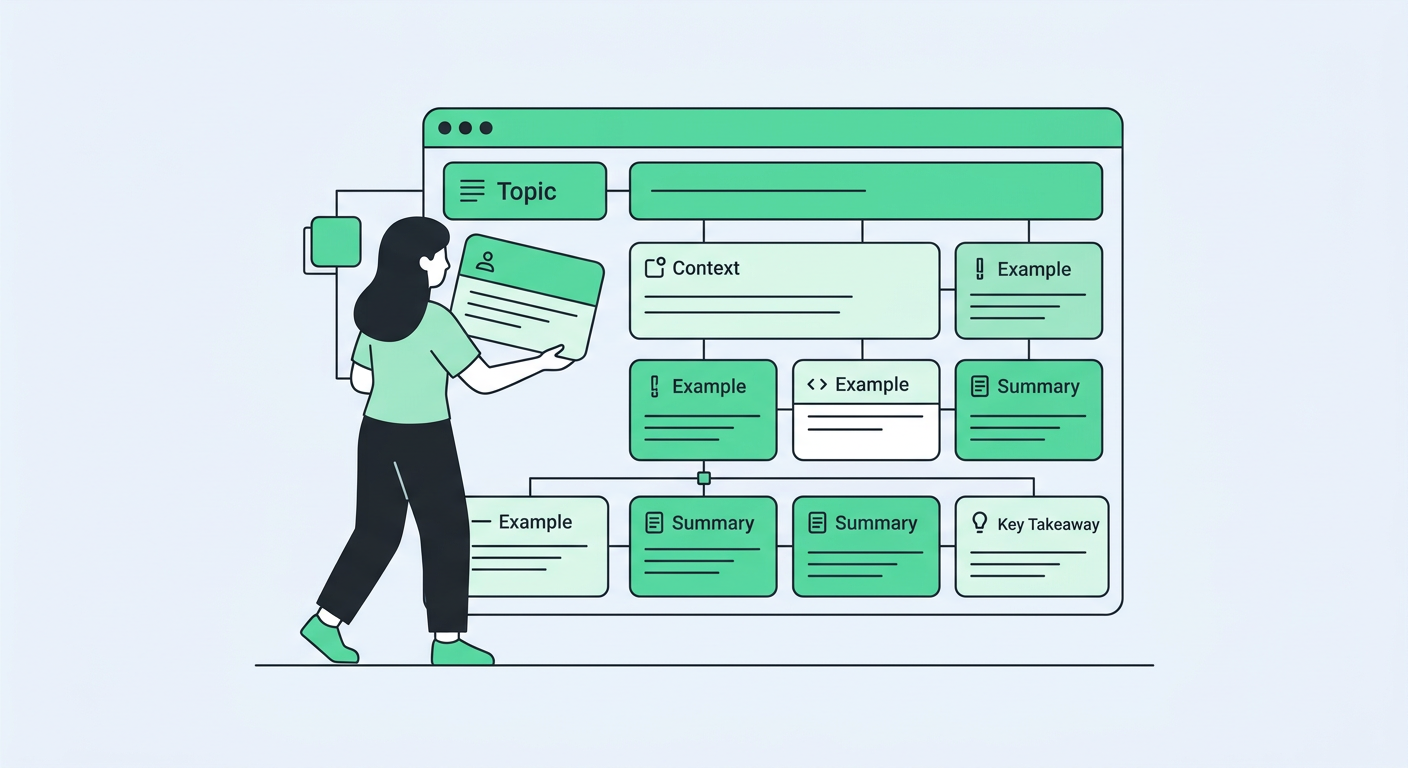
AEO works by improving how clearly your content communicates meaning. Answer engines look for signals that help them identify the topic, intent, authority, freshness, and usefulness of a page.
That sounds technical, but the practical work is familiar. You’re creating content that answers real questions better than competitors, then organizing it so both humans and AI tools can follow the logic.
Direct Answers
Every important section should include a short, standalone answer. If someone asks, “What is AEO?” they shouldn’t have to read eight paragraphs before getting a definition.
A good answer is usually two to four sentences. Then you can expand with examples, context, charts, steps, and nuance.
Topic Depth
Answer engines prefer content that covers a topic completely without wandering. A single article about AEO should explain definitions, benefits, examples, SEO differences, implementation steps, and measurement.
That’s where topical authority matters. If your site has related content around AI visibility, semantic SEO, technical SEO, and content strategy, your AEO page looks less isolated and more trustworthy. For planning this ecosystem, a free topical map generator can help organize pages into pillars and clusters.
Entity Clarity
Entities are recognizable things, such as brands, people, products, platforms, tools, locations, and concepts. If your article discusses answer engines, it should naturally mention Google AI Overviews, ChatGPT, Gemini, Claude, Perplexity, LLMs, featured snippets, schema markup, and E-E-A-T where relevant.
This helps AI systems understand what your content is about and how it connects to other known concepts.
Trust Signals
AEO content should include verifiable facts, named sources, author expertise, clear dates, original examples, and transparent claims. You don’t need to make every paragraph academic, but you do need to show that your content is grounded.
The original academic paper on Generative Engine Optimization introduced GEO as a framework for improving visibility in generative engine responses. It’s worth reading if you want the deeper theory behind the trend: GEO academic paper.
AEO vs SEO: What’s Actually Different?
SEO and AEO overlap, but they focus on different outcomes. SEO is about helping pages perform in organic rankings. AEO is about helping answers, facts, brands, and recommendations appear inside AI-driven responses.
Think of SEO as the foundation. If your site is slow, thin, confusing, or technically broken, AEO won’t magically fix it. Answer engines still need crawlable pages, useful content, internal links, and authority signals.
But AEO adds a new layer. You’re not just optimizing around keywords. You’re optimizing around questions, entities, summaries, and decision-ready answers.
If you want a deeper comparison, Marvlus has a dedicated guide on AEO vs SEO. It’s a useful next read if you’re deciding how to balance old-school ranking work with AI visibility.
The Core Elements of a Strong AEO Page
AEO is not one trick. It’s a group of content, structure, and credibility habits that make your page easier to trust and reuse in answer-style experiences.
Clear Definitions Near the Top
If your page explains a glossary term, define it early. Don’t hide the definition under a long personal story or sales pitch.
For example, if someone asks what is answer engine optimization, the page should answer that directly before moving into history, benefits, examples, and tactics.
Question-Based Headings
Question headings match how people ask AI tools for help. Use headings like “How does AEO work?” or “Is AEO the same as SEO?” when they fit naturally.
This makes your content easier to scan and easier for AI systems to map to user intent.
Concise Summaries
Add short summaries after complex sections. AEO-friendly writing doesn’t mean dumbing things down. It means making your best points easy to understand and reuse.
Busy readers love this too. Nobody complains when a useful article is easier to read.
Tables and Lists
Tables help compare options quickly. Lists help organize processes, pros, cons, steps, and examples.
For AEO, tables are especially useful for comparison terms like SEO vs AEO vs GEO, tools, pricing, platforms, content types, and workflows.
Original Examples
Generic content is everywhere. Original examples make your content more useful and more memorable.
Instead of saying “optimize for user intent,” show what that means for a dentist, SaaS founder, Shopify store, local service business, or affiliate blogger.
How to Build an AEO Strategy Step by Step
You don’t need a giant team to begin. AEO is often a practical upgrade to content you already have.
Step 1: Find Answer Opportunities
Start with the questions customers already ask. Look at sales calls, support tickets, live chat logs, product reviews, Reddit threads, competitor FAQs, Google “People Also Ask” boxes, and your own analytics.
Good AEO topics often start with:
- What is…
- How does…
- Best way to…
- X vs Y…
- How much does…
- Why does…
- Is X worth it…
The goal is to map real questions to pages that can answer them clearly.
Step 2: Create a Direct Answer Block
For each target question, write a short answer that stands alone. Put it near the top of the page or section.
Then expand below it with context. This structure gives readers a fast answer while still giving them the depth they need to make decisions.
Step 3: Strengthen the Page Structure
Use descriptive H2 and H3 headings. Break up long paragraphs. Add comparison tables where useful. Include FAQs when the topic has follow-up questions.
This is not just for AI tools. It makes the page feel cleaner, faster, and more trustworthy for visitors too.
Step 4: Add Proof
Support important claims with named sources, current stats, expert quotes, product screenshots, case studies, or first-hand experience.
If you’re writing about pricing, include real pricing. If you’re writing about a tool, mention actual features. If you’re making a claim about behavior, link to the study or platform documentation that supports it.
Step 5: Connect Related Pages
AEO works better when your site has a clear topic network. One strong article is good. A connected cluster of helpful pages is better.
Internal links help readers move through your expertise and help algorithms understand relationships between pages. A page about AEO might link to topical authority, AI visibility, technical SEO, FAQs, and comparison guides.
Step 6: Track AI Mentions and Gaps
You can’t improve what you never measure. Check whether your brand appears in AI answers for relevant prompts, whether competitors are mentioned more often, and which pages lack clear answers or source quality.
A free AI website audit can help identify missing AEO and GEO signals, including topic depth, answer-friendly formatting, AI visibility gaps, and content structure issues.
Common AEO Mistakes to Avoid
AEO is still new enough that bad advice spreads fast. The good news is that most mistakes are easy to fix once you know what to look for.
Writing for Bots Instead of Buyers
Some teams make content so robotic that no real person would enjoy reading it. That misses the point.
Answer engines are trying to satisfy people. If your content is clear, useful, specific, and credible for humans, you’re already moving in the right direction.
Publishing Thin FAQ Pages
FAQs help, but only when they answer real questions well. A page with ten shallow questions and one-line answers won’t build authority.
Use FAQs to reinforce the article, not replace it.
Ignoring Brand Clarity
If your company does something specific, say it clearly. Who do you help? What problem do you solve? What category are you in? What makes you different?
AI tools can’t recommend or mention a brand they can’t understand.
Treating AEO as a One-Time Task
AEO is ongoing. Topics evolve, AI platforms change, competitors improve, and old stats expire.
Refresh important pages regularly, especially definitions, comparisons, pricing references, tool roundups, and industry trend content.
AEO Examples for Different Businesses
AEO looks different depending on your model, but the principle is the same: answer the buyer’s real question better than anyone else.
Local Service Business
A local HVAC company could create a page answering, “Why is my AC running but not cooling?” The page should provide a direct answer, safety warnings, troubleshooting steps, when to call a pro, and local service details.
That page could earn visibility in Google AI Overviews, voice answers, and assistant-style recommendations.
eCommerce Brand
A skincare store could answer, “What’s the best moisturizer for dry sensitive skin?” AEO-friendly content would compare ingredients, skin types, product formats, dermatologist guidance, and customer concerns.
The goal is not just to rank a product page. It’s to become a trusted answer for a buying decision.
SaaS Company
A SaaS company could build comparison pages such as “project management software vs task management software.” The page should define both, compare use cases, list best-fit scenarios, and include honest limitations.
AI systems tend to favor clear, balanced explanations over hype.
Blogger or Publisher
A blogger can use AEO by turning scattered posts into structured guides. Add definitions, summaries, tables, FAQs, examples, and current sources.
This makes older content more useful without starting from scratch.
How to Measure AEO Performance
AEO measurement is still developing, but you can track meaningful indicators today.
Start with your classic SEO metrics: rankings, impressions, clicks, conversions, backlinks, page engagement, and assisted conversions. Then add AI visibility checks.
Useful AEO metrics include:
- Brand mentions in AI tools
- Competitor mentions in AI tools
- Featured snippet wins
- AI Overview appearances
- Traffic from AI platforms
- Ranking changes for question-based queries
- Conversions from educational content
- Growth in branded demand
Don’t obsess over one metric. AEO is about visibility, trust, and influence across the buyer journey.
A Progressive Content Strategy for Day 1
If you’re just starting, don’t try to optimize every page at once. Pick a manageable Day 1 workflow.
First, choose one important glossary or beginner guide topic. For example, answer engine optimization, AI visibility, topical authority, semantic SEO, or Google AI Overviews.
Next, build one strong pillar page around the term. Include a clear definition, comparison table, examples, step-by-step process, mistakes, metrics, and FAQs.
Then create supporting pages that answer related questions. Link them together. Over time, this creates a content cluster that helps readers and AI systems understand your expertise.
This is how smaller brands compete. Not by publishing random posts every week, but by building a connected library of useful answers.
Improve Your AI Visibility With a Clearer Roadmap
If you’re not sure how AI systems understand your website today, start with a quick audit instead of guessing. Marvlus helps website owners and marketers review AI visibility, SEO opportunities, content gaps, and practical next steps in one workflow.
Run a scan, find the pages that need attention, then improve your content one priority at a time. It’s a smarter way to grow Google rankings, AI mentions, and traffic without drowning in technical SEO busywork.
Frequently Asked Questions
Is answer engine optimization the same as SEO?
No. AEO and SEO overlap, but they are not identical. SEO focuses on ranking pages in organic results, while AEO focuses on helping content become the direct answer inside AI tools, snippets, voice assistants, and answer-style platforms.
Does AEO replace traditional SEO?
No. AEO builds on SEO fundamentals like crawlability, technical health, helpful content, internal linking, and authority. If your SEO foundation is weak, your AEO efforts will usually struggle too.
What types of content work best for AEO?
Definitions, comparison guides, FAQs, tutorials, pricing explainers, troubleshooting guides, product roundups, and industry glossaries work especially well. These formats naturally match the way people ask questions.
How long does AEO take to work?
It depends on your site authority, topic competition, content quality, and how often AI platforms refresh their data. Some improvements can help snippets and rankings within weeks, while broader AI visibility usually takes consistent work over months.
Do I need schema markup for AEO?
Schema can help clarify content types, but it’s not a magic switch. Use schema when it accurately matches the visible page content, such as FAQ, Article, Product, LocalBusiness, or Review markup.
Can small businesses benefit from AEO?
Yes. Small businesses often have specific expertise, local knowledge, and customer questions that larger competitors ignore. Clear answers, strong examples, and well-structured pages can help smaller sites earn more visibility.
What is the first page I should optimize for AEO?
Start with a page tied to a high-intent question your buyers already ask. Good candidates include your main service page, a comparison page, a beginner guide, or a glossary page explaining your core category.
Conclusion
Answer engine optimization is really about clarity. If your content answers real questions, proves its claims, connects related topics, and makes your expertise easy to understand, you’re building for the way discovery now works.
The brands that win won’t be the ones chasing hacks. They’ll be the ones publishing helpful, specific, well-structured content that both people and AI tools can trust.
Start with one page. Make the answer unmistakable. Then build the topic cluster around it.