
AI-powered answers are changing how people discover products, services, and expert advice. Instead of clicking through ten blue links, they can ask one detailed question and receive a summarized recommendation in seconds.
That creates a new opportunity for website owners. If you want to rank your website in ChatGPT, the goal is not to chase a secret algorithm. It is to make your brand easy to crawl, understand, trust, and recommend when your ideal customer asks a relevant question.
| Priority | What to Improve | Why It Matters | Effort |
|---|---|---|---|
| High | Crawl access | Makes pages discoverable | Low |
| High | Helpful content | Builds trust and relevance | Medium |
| High | Brand clarity | Helps AI connect facts | Medium |
| Medium | Structured data | Clarifies page meaning | Medium |
| Medium | Mention tracking | Shows what is working | Low |
1. Allow OpenAI’s Website Crawler
ChatGPT cannot surface content it cannot access. Check your robots.txt file, hosting settings, firewall, and content delivery network to make sure OpenAI’s OAI-SearchBot is not blocked from public pages you want people to find.
OpenAI states that allowing OAI-SearchBot helps make content eligible for inclusion in ChatGPT answers. This is a foundational technical check, especially if you use aggressive bot protection through Cloudflare, Akamai, or a similar service. Review OpenAI’s publisher guidance before changing access rules.
2. Publish Content That Answers Specific Questions
Generic pages rarely stand out in conversational AI. We get better results when we create pages around complete customer questions, such as “What is the best payroll software for small agencies?” or “How much does website redesign cost for a SaaS company?”
Build each page around one clear intent. Answer the question early, explain the reasoning, include practical details, and cover common follow-up questions so your content can support a fuller AI-generated answer.
3. Demonstrate Real First-Hand Experience
AI systems and readers both need a reason to trust your advice. Add original screenshots, testing notes, customer examples, product comparisons, step-by-step workflows, and lessons learned from actual work.
Google’s people-first content guidance emphasizes experience, expertise, authoritativeness, and trust. The same principle is useful for AI visibility because original evidence gives your content something that copied summaries cannot offer. Read Google’s people-first content guidance for a practical quality checklist.
4. Make Your Brand Facts Consistent Everywhere
Your business name, category, leadership team, location, products, pricing approach, and core expertise should be consistent across your website and reputable third-party profiles. Conflicting facts create confusion for people and machines alike.
Start with your About page, contact page, social profiles, directory listings, review platforms, and major partner pages. We also recommend using the same concise brand description in the places where it naturally belongs.
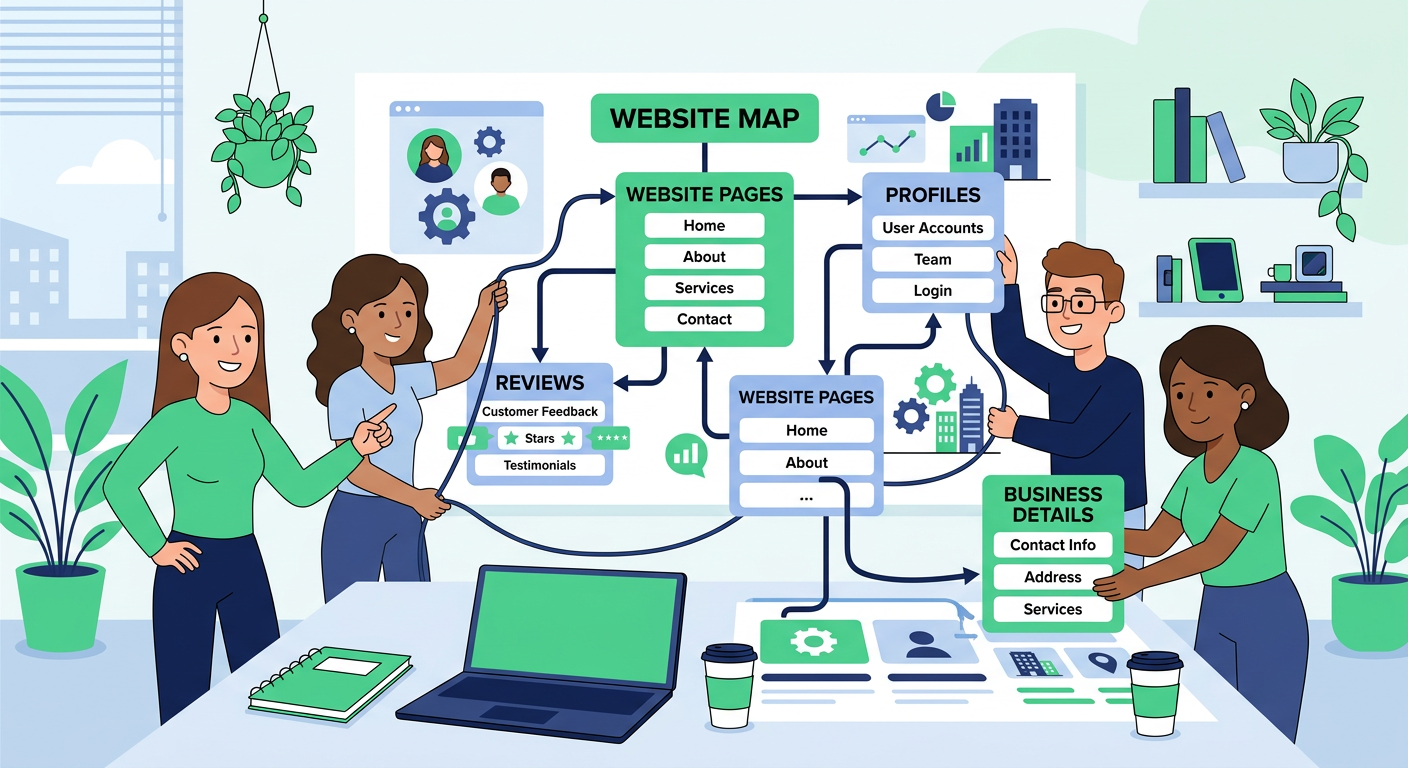
5. Build Topic Clusters Instead of Isolated Blog Posts
One excellent article is useful, but a connected library is stronger. Create a pillar page for a broad topic, then link it to supporting guides, comparison pages, templates, FAQs, case studies, and service pages.
For example, an agency offering ecommerce design could build content around platform selection, conversion-focused product pages, checkout optimization, accessibility, store speed, and redesign costs. This topical depth helps establish what your site is genuinely qualified to discuss.
6. Use Clear Headings and Direct Answers
Write pages so a busy reader can scan them in seconds. Use descriptive headings, short paragraphs, comparison tables, ordered steps, definitions, and concise answers near the top of important sections.
This is not about writing for robots. It is about reducing ambiguity. When your page clearly states what something is, who it is for, how it works, and when it is useful, ChatGPT has a cleaner source to understand and reference.
7. Add Useful Structured Data
Structured data gives machines extra context about the content on a page. Depending on your business, that may include organization, product, service, article, FAQ, review, local business, breadcrumb, or person markup.
It will not guarantee a mention, but it can make important details more explicit. Google explains that structured data helps systems understand page content and potentially present it in richer ways. Use the supported formats described in Google’s structured data documentation.
8. Keep Important Content Visible in the HTML
A beautiful interactive website can still have an accessibility problem if key information only appears after complicated scripts run. Product descriptions, service details, pricing context, expert bios, and customer proof should be visible and readable without requiring users to click through multiple hidden elements.
Ask your developer to test what a crawler can access. If your core content is trapped behind a login, endless scroll, accordions, or client-side rendering issues, you may be making discovery harder than it needs to be.
9. Strengthen Your Author and Company Pages
Anonymous content has a trust ceiling. Give readers a clear picture of who created the advice, why they are qualified, and how they developed their point of view.
Include author bios, professional credentials, relevant experience, editorial standards, and links to supporting profiles where appropriate. For agencies and SaaS brands, show the team, explain your process, and make it easy to verify that a real organization stands behind the website.
10. Earn Credible Third-Party Mentions
Your website is only one source of information about your brand. Mentions in industry publications, professional directories, review sites, podcasts, conference pages, partner websites, and respected communities can reinforce your relevance.
Focus on quality over volume. A legitimate feature in a trusted niche publication or a detailed customer case study can be more valuable than dozens of low-quality directory listings.
11. Create Comparison and Alternative Pages Carefully
People often ask ChatGPT for the best option, the most affordable tool, or alternatives to a popular brand. Well-researched comparison content can help you appear in these high-intent conversations.
Be fair and specific. Explain who each option suits, list meaningful tradeoffs, update pricing details regularly, and avoid pretending every competitor is weak. Honest comparisons build credibility because they help readers make a decision, even when your brand is not the best fit.
12. Add Proof That Supports Your Claims
Vague claims like “industry-leading” and “best-in-class” are easy to write and hard to trust. Replace them with measurable proof, including customer outcomes, implementation timelines, product specifications, methodology, case studies, testimonials, and independently verifiable data.
A useful rule is simple: if a prospect asks, “How do you know that?” your page should provide an answer. Original proof also makes your content more likely to be useful in AI-generated summaries.
13. Keep Important Pages Fresh and Accurate
Outdated pricing, discontinued services, old screenshots, and stale statistics can weaken trust. Create a recurring review process for your most valuable pages, especially comparison posts, buying guides, product pages, and articles that cover fast-changing topics.
Do not update dates just to look fresh. Make meaningful improvements, note material changes when helpful, and remove claims you can no longer support. Accuracy is part of authority.
14. Improve Traditional SEO Alongside AI Visibility
ChatGPT can draw on web sources and third-party providers, so strong traditional SEO still matters. A technically healthy site, useful content, crawlable pages, logical internal links, and reputable backlinks all increase the chances that your content is discoverable across the wider web.
Make sure important pages are included in your XML sitemap and linked from relevant pages on your site. Google’s sitemap guidance explains how sitemaps help crawlers identify important URLs and related content.
15. Track Prompts, Mentions, and Competitors Over Time
You cannot improve what you never measure. Create a short list of real questions your prospects ask, then check whether your brand, competitors, and trusted publications appear in the responses.
Look for patterns. Are you missing from product comparisons? Does your company appear for broad educational questions but not buying-intent prompts? Do competitors earn mentions because they have more case studies, clearer pricing, or stronger third-party proof?
For a faster baseline, use the free AI website audit from Marvlus to identify visibility gaps, content opportunities, competitor signals, and technical issues that may limit your reach.
Common Mistakes That Limit ChatGPT Visibility
Even strong brands can lose visibility by making a few avoidable mistakes:
- Blocking important crawlers through robots rules or security settings
- Publishing thin pages that repeat what competitors already say
- Hiding core content behind scripts, tabs, or login walls
- Using inconsistent brand names, services, or business details
- Making unsupported claims without evidence
- Writing pages only for keywords instead of customer questions
- Ignoring how competitors are described across the web
Here’s the thing: no one can guarantee a top placement in every ChatGPT response. OpenAI says results depend on multiple reliability and relevance factors, so the smartest strategy is to build a website that deserves to be mentioned.
Frequently Asked Questions
Can you guarantee that a website will rank in ChatGPT?
No. There is no guaranteed top position because responses can vary by question, context, freshness, location, available sources, and the user’s follow-up prompts. We can improve the signals that make your website easier to discover and trust.
Does ChatGPT use the same ranking factors as Google?
Not exactly. Traditional SEO remains valuable because strong websites are easier for many systems to discover, interpret, and trust. However, conversational answers also depend heavily on direct relevance, clear facts, source quality, and how well content addresses the full question.
How long does it take to appear in ChatGPT results?
There is no fixed timeline. Technical crawl access may be resolved quickly, but building credible content, earning mentions, and establishing topical authority usually takes consistent work over weeks or months.
Is structured data required for ChatGPT visibility?
No, but it is often helpful. Structured data gives machines clearer context about your organization, services, products, authors, and content, which can reduce ambiguity around important details.
Should we create content specifically for ChatGPT?
Create content for your customers first. The best AI-friendly content is clear, accurate, well-organized, evidence-backed, and genuinely useful to a person who lands on the page.
Do backlinks still matter for AI visibility?
Yes, credible links and mentions can strengthen your broader authority and help reinforce that your brand is recognized by other trusted sources. Focus on earning relevant editorial coverage rather than chasing volume.
Find Your Biggest AI Visibility Opportunities
Want a clearer picture of how your website appears across AI-powered answers? Run a free AI website audit with Marvlus to uncover content gaps, technical issues, authority signals, and practical next steps.
You can also track brand mentions and real customer prompts for free, so your team can see where you are gaining visibility and where competitors are winning the conversation.
Build a Website Worth Recommending
The best way to rank your website in ChatGPT is not to hunt for shortcuts. Build clear pages, publish original expertise, verify your technical foundations, keep facts accurate, and earn recognition from trustworthy sources.
When we treat AI visibility as an extension of helpful marketing rather than a separate trick, the work improves every channel. Your website becomes easier to understand, more useful to prospects, and far more credible when the right question is asked.